Ways O Brother Where Art Thou and the Odyssey Are Similar
Editor's Notation: This is a comparing between the ancient epic, The Odyssey and the mod moving picture O Brother, Where Fine art 1000? One important point is that in the citations for the picture show, the fourth dimension on the DVD version of the movie is given. In other words, if you go to that item point on the DVD, y'all tin meet what is being discussed.
Every bit long as humans have gathered together, they take told stories. I of the archetypes of storytelling is that of the lost soul, struggling to find his or her way habitation. Tumultuous experiences, terrible odds, and horrifying foes confront the protagonist, who must overcome them all, in order to successfully complete the journey. One of the iconic examples of this archetype is Homer'south The Odyssey, which tells of Odysseus (or Ulysses) and his try to render to his dwelling house in Ithaca, after the conclusion of the Trojan State of war. Every bit such, Homer'south epic poem serves equally a sort of sequel to The Iliad. Since this work was originally penned nearly iii thousand years ago, many others have taken up the story and use it as a foundation for new renditions. Recently, the Coen Brothers, Joel and Ethan, used The Odyssey as the structural foundation for their popular moving-picture show, O Blood brother, Where Are Thou?.
While not an exact transposition of Homer's original, the influence that the written work has on the movie is evident. Both versions bear witness the protagonist struggling to attain home in lodge to save his family unit. Both allow for supernatural elements to oppose, or at times to back up, the hero on his journey. Many of those opposing characters are transferred from Homer to the Coens' version, but they are usually adapted to fit the context of the film. In essence, this story serves as a case study for what Robert Stam refers to every bit fidelity between pic and novel (or written work). What does it mean to have a piece of literature and put it onto picture show? Is information technology appropriate for the filmmaker to make changes, or must he or she tell the story exactly as written? The example in question, the Coen Brothers' movie, demonstrates that information technology is advisable and proper for filmmakers to adjust, rather than copy, the literary work. While at that place are elements of storytelling that transcend the medium, there are many that practise not, and therefore each medium must stand on its own merits. Therefore, information technology is appropriate to consider the elements that are inherent in film and novel, and how those tin, or cannot, exist transferred from one to the other. Using examples from both stories, the method of storytelling, and the benefits and advantages of each tin be made evident.
Story Summary and Organization
Both versions tell of a human being, Odysseus in the written work and Ulysses Everett McGill (called Everett in the moving picture), who finds himself in dire straits for an extended period of time, fighting to return to his wife and child(ren). Companions share these experiences, some for long periods of time and others briefly, however the protagonists focus on their ultimate goals, rather than on the needs or cares of the companions. Adversaries are placed before them, some more dangerous than others, and all are overcome. Eventually, the hero in each story finds himself returned to his loved ones, a wiser and more than dedicated family human being. While the basic story can be reduced to a few sentences, Homer utilized over 12,000 metered lines to flesh out the story, while the Coen Brothers used approximately an hour and twoscore-5 minutes of screen time. The details that brand upwards the bulk of each work demonstrate the similarities and differences in construction, focus, and storytelling approach.
Both film and epic poem employ a similar construction; at that place is much parallel editing. Patently, every bit the details of the story are changed so much, at that place are differences in what is taking place, merely the manner in which the stories are organized is very similar. For example, Homer's poem volition have Odysseus in i location, where he must recount past events, allowing the reader to gain important background data. The scene itself is non presented in real time, only is retold after the fact, such equally his business relationship of Polyphemus in Book IX. Likewise, in that location are sections when the story focuses upon Odysseus and others where Telemachos (or Athena) is the focal graphic symbol. In this manner, a form of parallel editing is utilized in the story.
The film uses these same characteristics. For the majority of the film, it is assumed that Everett is leading his companions to a financial windfall, but in the end, he must admit to them that he received a letter from his ex-wife, who will shortly marry another, prompting his escape plan. This is data that the characters, and the audition, are given after the fact, allowing them to reinterpret earlier events. Two carve up story lines are also used in the motion picture; ane follows Everett and his companions, while the other provides needed data, regarding an ongoing political race that will become important at the end of the story. Again, parallel editing is used in the pic, simply as in the written work.
Odysseus and Everett
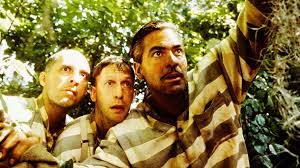 Perchance the near obvious divergence in the two versions of the story is the fact that Odysseus is a famous king and warrior, while Everett is a convicted con human being who has escaped prison. Odysseus is motivated to render to his loved ones and to regain his rightful identify as ruler. He is generally forthright about his identity and purpose, unless he is absolutely required to deceive, while Everett tends to operate in the opposite manner. Normally, he is lying, unless it is absolutely necessary to tell the truth. Everett was motivated to interruption out of his incarceration in gild to terminate his married woman from marrying another man – i who would normally be considered a better choice of hubby. Both characters are arrogant and cocky-centered, but Odysseus assumes his status every bit rex and soldier provides him this right, while Everett just assumes a loftier status, with footling reason or justification. The pride of both characters is made manifest through the presentation their fastidious nature. On occasion, Odysseus referred to his own appearance and prowess, how he had owned fine clothes and drawn the eyes of women (Cf. Volume 19, p. 357). Everett is obsessed with his hair, repeatedly announcing that he is a "Dapper Dan man" (Cf. 11:20 – eleven:30; 19:10 – 19:30).
Both men are decumbent to apply others to attain individual goals, fifty-fifty if it means the others must endure or die. Odysseus leaves a trail of broken and dead men in his wake, while Everett convinces his two prison-mates to escape with him, though i of them is due to be released in just a few days. Everett has no business organization for the others, every bit long equally his own needs are met. In this way, the Coen Brothers carried over i of Odysseus'southward primary personality traits. In the aforementioned way, they utilized Odysseus's ability to use words. Both characters are presented as eloquent speakers, able to influence others with their ability to communicate.
In the penultimate confrontation in each story, matters keep differently and the resolution of the problem is uniquely handled in each. Odysseus, disguised as a beggar, eventually demonstrates his forcefulness and prowess, strings his legendary bow, and kills his adversaries. His wife and daughters easily recognize Everett, disguised in order to avoid being recaptured by the government, and when his main adversary is confronted, Everett is soundly whipped. Regardless of the differences, in the cease, both men accomplish their goals, regain their quondam positions, and win their wives.
Comparison and Dissimilarity of Supporting Characters
One of the major differences between the ii tales would be the importance of the hero's offspring. In The Odyssey, Telemachos is vital to the story. In fact, he is 1 of the principal motivations for Odysseus to return home, as the son will soon past murdered by interlopers who are attempting to take Odysseus' rightful place as male monarch. Non merely does the son show to be an impetus for Odysseus, he takes on an important role in his ain right (consider Book Ii: "A Hero's Son Awakens" and Book Sixteen: "Begetter and Son"). He sets out to seek his father, he opposes the enemy at home, and he holds things together until the father returns, when they both ultimately overcome the suitors. In the picture show, all the same, there is no son. Everett has several children, all daughters (beginning seen at 59:38). At that place is no danger to the daughters by suitors or interlopers. Everett's daughters are young and have a very minimal role in the pic.
Likewise, the enemies that are encountered by Odysseus and Everett articulate a fidelity to the essence of the story, while clearly demonstrating that that essence tin can be presented in multiple ways. Consider the Cyclops. Odysseus matches wits and strength with Polyphemus in Volume Ix, blinding him and escaping, after the monster kills and eats some of the hero's men (156, 160-61). Conversely, Everett encounters a one-eyed bible salesman who beats him and robs him, and crushes a frog that is believed to be a bewitched companion (49:twenty – 54:thirty). Somewhen the bible salesman meets a biting end, just every bit Polyphemus, and then it is articulate that there are similarities in the villains: ane middle, evil intentions, abuse of the hero, expiry (or at least perceived death) of companions. At that place are also differences between the ii versions of Cyclops. Polyphemus is Poseidon's son, and his prayers to his father contribute to Odysseus's problems. The Coens' bible salesman has no lineage (though the bible connection provides an interesting religious connectedness), and he steals Everett's money and automobile, and he abandons his victims, rather than them escaping through their wits. Both versions provide for a worthy adversary, who hinders the progress of the hero, and the differences showcase that both are suited to their settings.
Similarly, Odysseus is tempted by the Sirens, desiring to get to them, but prevented from doing so because he is lashed to the ship's mast, while his men accept their ears plugged and cannot be seduced by the Siren's song (Book XII, 214ff.). Everett, on the other hand, non but encounters an equivalent of the Sirens, but so do his friends. We are not certain exactly what transpires at the moment of contact, simply one companion is temporarily lost and Everett and some other companion are rendered unconscious (42:forty – 45:xx). While Everett is not physically damaged, the Sirens do play a function in slowing his progress toward his ultimate goal.
At that place are many other minor characters that are presented in both versions, but 1 important similarity is the way both stories bring in popular cultural figures of the day. In Book Xi: "A Gathering of Shades," Odysseus converses with several ghosts of famous expressionless people. Some of these are former companions, family members, and friends, just most are well known individuals, who would be readily recognizable to the contemporary readers; Achilles, Agamemnon, Heracles, and others are brought before Odysseus to give advice, provide history, and to establish the hero's bona fides.
Everett does not speak with the expressionless, but characters such as George "Baby Face" Nelson run across his path. Nelson was a famous gangster of the Low-era and would take been recognizable by the contemporary audition. The characters, fifty-fifty when based upon historical persons, are fictionalized, simply they lend credence to the setting and provide texture and depth to Everett's journey.
Adaptation
The primary and most obvious alter is the altered setting. While Homer places his hero in the immediate aftermath of the Trojan War, the Coens ready Everett in the midst of the Slap-up Low. Odysseus travels primarily by ship, while Everett rides in automobiles. While both versions have the protagonists kept as prisoners at one time or another, the written story has him kept in caves or jump by supernatural entities. The moving picture utilizes a chain gang. This change in setting affects the mese-en-scène, which refers to the world of the story: what is staged, the setting, the reality in which the film or poem operates (Villarejo 28). The differences demonstrate that in that location is flexibility in what is translated from the text to the screen. The story, characters, theme, and other elements are not set in stone, but are variable, to be adjusted by the director and writer to fit the particular context of the piece of work (Hutcheon 8, ten-12).
In the context of the Depression, the Coens' moving picture also includes a political race equally a backdrop, to compare with Homer's sea voyage setting. The political components of the written story are limited to Odysseus returning home to assume his role as king, taking his place with his queen. Everett has no such inclination, just the film's politics address more pressing social considerations of the modern world: racism, cronyism, dishonest politicians, and the similar. Through this changed setting, the Coens are able to make social commentary in a way that would be missing had they limited the setting to one identical to Homer's.
And so why did the Coens not include a son in the picture show version? The elementary answer is that they did non consider it necessary. Homer wrote in ancient Greece, where paternal lineage was an important consideration. A man desired to have sons to continue on the family unit heritage. What would be Odysseus' motivation to return domicile to a daughter that must be married off to another? The Coens produced a film in a different era. No longer are daughters considered lesser offspring. In fact, Everett takes special notice that they are his daughters and should carry his proper noun. And so while the parental concern is seen in both versions, the change from son to daughters can demonstrate a difference in social considerations.
Dudley Andrew argues that "adaptation is the cribbing of a meaning from a prior text," and therefore the Coen Brothers are not required to produce the story verbatim, but rather to interpret the story to fit their own context (421). He goes on to fence that the differences in the 2 media require that there exist some differences in presentation (425). Of particular concern for Dudley was the idea of connotation and what the reader/viewer would interpret from the story. The changing audience, from ancient Greece to modern America, necessitates some drastic changes to contain the social connotations that may be applied. So the Coens no longer demand a son to tell their story. A set of daughters will work just likewise or better. Rather than attach particular importance to the father-son relationship of Homer, they are able to shift focus to the marital relationship between Everett and Penny (his wife). While the Odysseus-Penelope relationship was in of import part of the written piece of work, it may non exist equally important as that of Odysseus-Telemachos, which is not even a consideration in the moving-picture show.
Homer provides for a demi-god, the Cyclops Polyphemus, son of Poseidon, to oppose Odysseus. The Coens introduce "Big Dan" Teague, a traveling bible salesman in his place. The religious similarities are obvious, and the evil nature of both is rapidly adamant by the reader/viewer. The elementary fact is that a supernatural one-eyed monster would non fit into the Cracking Depression-era setting of the moving picture. A traveling salesman would be much more appropriate. Robert Stam argues that no filmmaker should truly be 100% committed to reproducing a written work. Not only would this usually entail a terribly long picture show (many, many hours in length), information technology would likewise bog the filmmaker down in details that simply do not make sense for that medium (15). He goes further to insist that if a filmmaker has zero new to add to the story, and so there is no purpose in filming it at all (16). Here, the Coens' work seems to validate Stam's concerns and admonitions.
In both versions, the hero is pursued and assaulted past supernatural forces. Odysseus is constantly hounded by the offended Poseidon, and simply escapes from his clutches through the aid of Athena and her interventions on his behalf (Book I, 2-three). Everett, afterward initially escaping from prison, is followed and harassed by a sinister beingness, who somewhen allows that he is not bound by "human institutions" and is set on killing Everett (1:34:00 – 1:37:00). Only the intervention of a overflowing saves Everett and his companions. The film entity is non Poseidon, though there is some symbolic irony in the fact that he is destroyed past water, but seems more akin to the Christian version of the devil, as described by the minor character Tommy (21:55 – 22:l). Once again, this demonstrates the differences in audience from one version to the other, from aboriginal Greece to modern America.
In the same style, music plays a vital role in the film, while not so of import in the written piece of work. Since the motion picture presents the story through sight and sound, it is but natural that such a medium will differ from the written work. This relates to Chatman'due south statement that films rely on visual and non-assertive details, while novels do not (407-8). While minstrels and singers are seen from time to time in Homer's work, they are not major characters (Volume VIII, 126). Music's role in the film is vastly dissimilar, as the Coens not merely have Everett and his shut companions present themselves every bit singers, producing a verifiable hit song, but the movie soundtrack becomes a major component of the storytelling itself. Odysseus is a warrior, while Everett becomes a vocaliser and glory. It is non his concrete force that saves him in the terminate, just his glory status equally one of the "Soggy Lesser Boys" (ane:24:30 – i:30:25). This is only i instance of the impact that music has on the film that is missing from the written story. The film Sirens sing "Become to Sleep My Little Baby," and other various religious and folks music songs are incorporated.
Of class, in a written work, there is little capability to share a musical number, outside of the lyrics themselves, and then the emotional impact of the song is muted. In a film, however, the opportunity to utilize musical scores allows the filmmaker the opportunity to influence and affect the audition in a profound way, equally the Coens' did in this case. The soundtrack was awarded a Grammy equally Album of the Year and reached the tiptop spot on the music charts, becoming an viii fourth dimension platinum album (Lewis). These facts demonstrate the power the music had on the audition and the wider culture to which the film continued. While Homer's original has demonstrated its importance and reception as 1 of the great stories of all time, and then the Coens' version has been well received, and to this bespeak, has maintained an admirable staying power. Information technology would be fair to say that the film introduced an entirely new audience to the story of Odysseus.
Conclusion
In that location are many other examples that could be drawn from 12000 lines of text and well-nigh 2 hours of film, but these are sufficient to demonstrate that while films and written works can tell the same or similar stories, information technology is not incumbent upon the director to reproduce the piece of work exactly. In fact, Stam and Hutcheon both argue that this is impossible to accomplish (Hutcheon 7). Information technology is imperative that filmmakers suit and recreate the story to fit a new audience, context, and medium. There is no art involved if the director is non adding a new twist or perspective, but when the film does add together a new element, then the story takes on a life of its own. Neither medium is inherently superior or inferior to the other. They are simply different.
Novels have the reward of great focus on detail, as the story line can be disrupted for a period of time to allow for detailed description. Movies cannot do this, as they must accept continuous action (Chatman 407-viii). This is one instance of a difference in the medium, but in many other aspects, the artists must "find his or her ain ways to evoke the sense of what the objects of the narrative wait similar," using the properties and techniques available inside the chosen medium (Chatman 419).
Are the two versions the same? Of course non. One is more traditional and ancient, concerned with social norms of a world long gone. The other is more modernistic, focused upon social concerns that are more prevalent today, and more than attainable to a modern audition. Both of these stories, yet, provide a wonderful look into the world of a homo who is haunted by demons, but focused upon a worthy goal, allowing nothing to end the eventual attainment of that desired consequence. In both versions, the protagonist is strong-willed and determined, an influential man who uses others to accomplish the tasks at hand and willing to put himself in danger to reach the prize. Homer and the Coen Brothers requite different looks at the aforementioned story essence. Neither is superior or inferior, they are just dissimilar. Both are outstanding in their ain way.
Works Cited
Andrew, Dudley. "Adaptation." From Concepts in Pic Theory. Oxford: Oxford Academy Printing, 1984. PDF file.
Chatman, Seymore. "What Novels Can Practice That Films Can't (and Vice Versa)." Critical Inquiry, Vol. 7, No. 1. (Autumn, 1980). Univ. of Chicago Press. 121-140. PDF file.
Homer. The Odyssey. Trans. Robert Fitzgerald. New York: Farrar, Straus, and Giroux, 1998. Print.
Hutcheon, Linda. "Start to Theorize Adaptation." A Theory of Adaptation. New York:Routledge, 2006. PDF File.
Lewis, Randy. "'O Brother', Is It ten Already?" L.A. Times. L.A. Times. (Aug 23, 2011). Web. 1 Aug 2014.
O Brother, Where Art Thou? Dirs. Joel and Ethan Coen. Perf. George Clooney, John Turturro, Tim Blake Nelson, and John Goodman. Universal, 2000. DVD.
Stam, Robert. "Introduction: The Theory and Practice of Accommodation." Literature and Pic. Eds. Robert Stam and Alessandra Rengo. Blackwell Printing, 2004. PDF File.
Villarejo, Amy. "The Linguistic communication of Motion-picture show." Film Studies: The Nuts. London: Routledge, 2006. PDF File.
mitchellrawastrand.blogspot.com
Source: https://www.menofthewest.net/odyssey-o-brother-art-thou/
Belum ada Komentar untuk "Ways O Brother Where Art Thou and the Odyssey Are Similar"
Posting Komentar